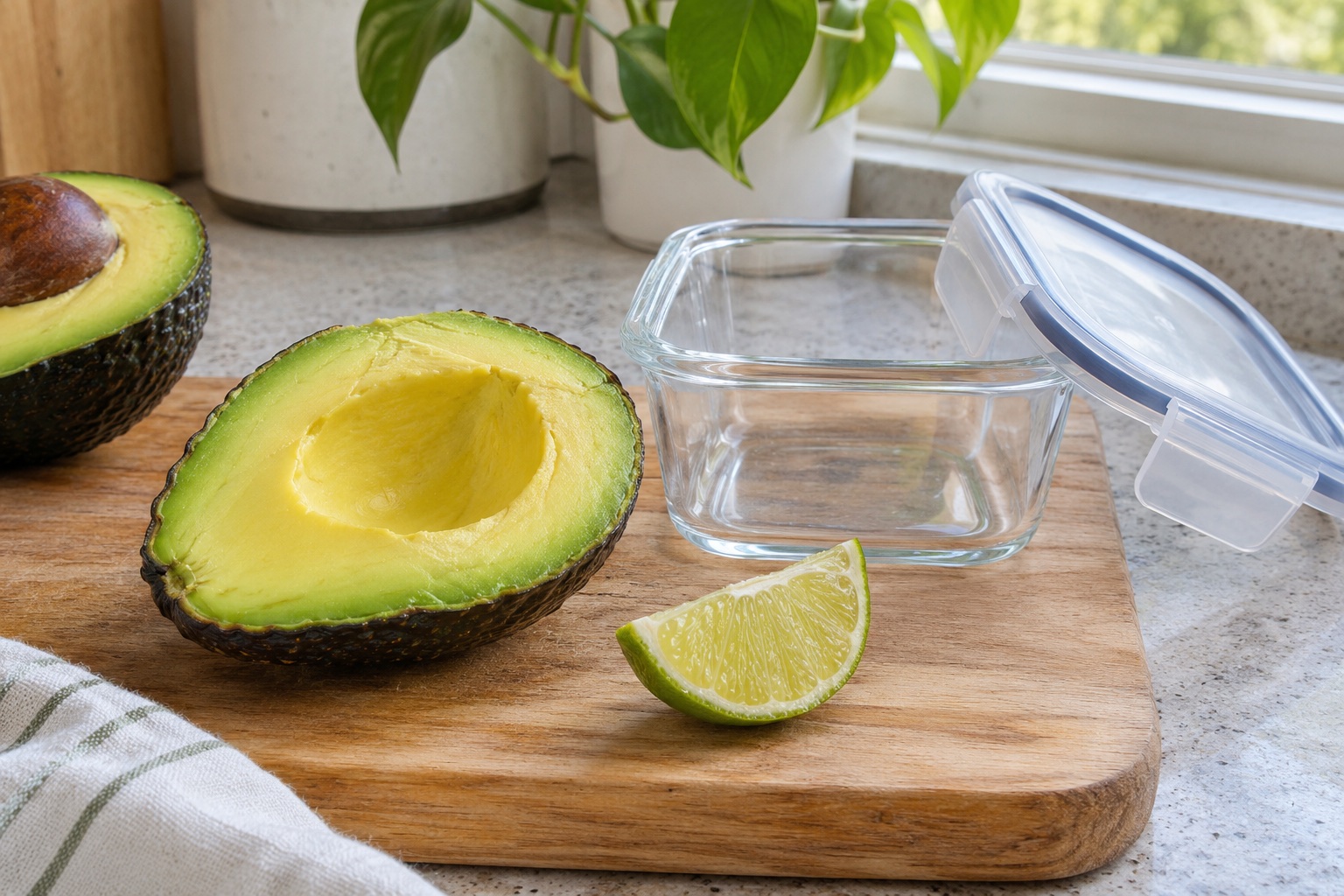
You use half an avocado at lunch and save the rest. By dinner, the cut side has turned brown. Is it spoiled? Do you need lemon juice, a special knife, or the old trick of putting guacamole under water?
The short answer: Keep air off the cut surface, add a little lemon or lime juice if the flavor fits, and refrigerate promptly. Those steps help with color and quality. They are not a substitute for clean handling or a cold refrigerator.
Two clocks start when you cut an avocado
The first is the color clock. Exposed avocado flesh reacts with oxygen and develops a brown surface. That is why citrus and a close-fitting cover can help. The second is the food-safety clock: once the protective peel is broken, the flesh can pick up germs from the peel, hands, knife, board, or other food. A green surface does not prove that food was handled safely, and a brown surface alone does not tell you that it was not.
The difference matters because you can slow browning without making an avocado safe to leave on the counter. The FDA advises washing produce under running water before cutting it, even when you will discard the peel. Its guidance also calls for clean hands, utensils, and surfaces. FoodSafety.gov advises refrigerating perishable food within two hours, or within one hour when it is above 90°F, and keeping the refrigerator at 40°F or below.
The two-minute method for an avocado half
- Start clean. Rinse the whole avocado under running water, rub the peel, and dry it with a clean towel or paper towel before cutting. Use a clean knife and board. Do not wash the fruit with soap or produce wash; the FDA does not recommend either.
- Cover the exposed flesh. If you like the flavor, lightly coat the cut face with lemon or lime juice. University of California Cooperative Extension recommends citrus on exposed avocado to slow browning. Press food-safe wrap against the cut surface, or use a small clean container that leaves little air above it. The closer the contact, the less exposed flesh there is to discolor.
- Chill it promptly. Put the covered half in the refrigerator at 40°F or below. Mark the container with the day you cut it if your refrigerator is crowded. Aim to use it the next day; a UC Master Food Preserver describes one to two days as a practical quality window for tightly wrapped cut avocado. That is a quality guide, not a guarantee of safety.
No lemon in the kitchen? Cover the cut face well and refrigerate it anyway. Citrus helps appearance, but cold storage and clean preparation do more important work. A pit can stay in the half if convenient; it only covers the spot it touches, so protect the exposed flesh around it.
For guacamole, make the surface your lid
Guacamole has much more exposed surface than an avocado half. Smooth the top with a spoon, add lime or lemon to taste, and press food-safe wrap directly against the surface before putting on the container lid. Refrigerate promptly. A UC Cooperative Extension guacamole recipe likewise pairs citrus with covering and refrigeration.
You may have seen advice to pour a half-inch of water over the dip and a promise that it will stay fresh for 24 hours or more. Do not treat that as a food-safety promise. A water layer does not replace chilling; a close cover is simpler and leaves the dip undiluted. If the guacamole contains yogurt, mayonnaise, or other perishable additions, follow the same prompt-refrigeration rule and use it soon.
What to skip, and what to keep
- Keep: citrus plus a snug cover. They address the color clock by limiting browning at the exposed surface.
- Keep: prompt refrigeration. That addresses the safety clock. Lemon juice, oil, or a tight lid cannot make room-temperature storage safe indefinitely.
- Skip: buying a special knife to solve browning. A clean knife, less air exposure, and prompt chilling matter more than the material of the blade.
- Skip: treating the pit or a layer of oil as a complete fix. Neither covers every exposed patch of flesh. Oil may also change the flavor of the avocado. Use a direct cover that you can see and remove.
Brown top or bad avocado?
A thin brown layer can be a color change from exposure to air. Judge the food by its handling history first: Was it washed and cut with clean tools, covered, and chilled promptly? If it sat out beyond the food-safety window, discard it even if it looks bright green. If the fruit is rotten, moldy, unusually watery, or has an off odor, discard it; the FDA says to throw away produce that looks rotten. Do not use a taste test to decide whether questionable food is safe.
When you have more ripe avocado than you can use, freezing mashed avocado with citrus is another option. Expect a softer texture after thawing; it is better for a spread or dip than for neat slices. UC Extension describes freezing avocado puree with lemon juice for better color. Thaw it in the refrigerator, not on the counter.
The next-time checklist
Before you cut: wash the peel and use clean tools. After you cut: citrus if you want it, a cover touching the exposed flesh, then the refrigerator. When you open it again: consider the time and temperature before the color. That routine is more useful than a miracle ingredient.
For more everyday kitchen questions, browse the PHH Food archive.
Sources and editorial note
- FDA: Selecting and Serving Produce Safely (clean preparation, washing before cutting, refrigeration, spoilage).
- FoodSafety.gov: Four Steps to Food Safety (two-hour/one-hour chilling rule and refrigerator temperature).
- UC Cooperative Extension: Guacamole and UC Master Food Preserver: The Awesome Avocado (citrus, covering, short-term storage), and Guacamole, Bruschetta and More! (freezing puree).
This guide addresses home handling and appearance, not a guaranteed storage life for any particular avocado. The original 2016 PHH article was refreshed to remove unsupported health and storage claims and an unrelated sales link.