
The price tag is only the beginning. A sauna can be beautiful and still fail the doorway test. A cold plunge can fit the patio and overwhelm the place where it will be filled. A full-body red light panel can promise easy sessions while its stand, eye guidance, and return terms stay buried three clicks deep. Those details are less glamorous than the product photo. They are also the details you live with.
We built this guide for the moment before a big home wellness purchase becomes a big household project. Start with the equipment that interests you, then work backward from the room, the routine, the evidence, and the exit plan. A good buy should still make sense on an ordinary Tuesday six months from now.
This hub does not rank or claim hands-on testing of specific products, and it currently has no affiliate purchase links. If that changes, we will identify the relationship here. Read our affiliate disclosure.
Find your first buyer guide
Answer five shopping questions. This points you to a guide and a checklist, not a medical or product recommendation.
Choose a guide from the category map below.
Choose the guide that matches the decision
Red light devices
Best starting point when you need to compare intended use, model-specific claims, output at a stated distance, coverage, eye guidance, format, and opened-item returns. Open the red light buyer guide.
Home saunas
Best starting point when the decision depends on room fit, delivery, electrical work, ventilation, heat safety, installation, and separate heater or electronics coverage. Open the home sauna buyer guide.
Cold plunges
Best starting point when you need to plan safe access, filled load, drainage, chilling, sanitation, protected power, freeze exposure, and heavy-component service. Open the cold plunge buyer guide.
Premium mattresses
Best starting point when fit, sleep preferences, foundation rules, delivery, trial use, returns, sag definitions, and adjustable-base terms matter. Open the premium mattress buyer guide.
Compare four categories with one framework
| Category | Site or fit question | Safety question | Ownership question | Worst-case return question |
|---|---|---|---|---|
| Red light | Can the stated distance and coverage be maintained safely? | What eye guidance, warnings, and intended use appear in the exact manual? | How are the power supply, controller, stand, straps, or battery serviced? | Can an opened or used device be returned, and who pays insured shipping? |
| Sauna | Do the delivery path, floor, room, clearances, power, and ventilation match the manual? | Who should seek medical guidance, and what symptoms mean leave immediately? | Who services wood, heater/panels, controls, labor, and travel? | Does assembly or installation end return eligibility, and who pays freight? |
| Cold plunge | Can the site support the filled system and handle water, drainage, service access, and weather? | Is there supervised entry, a clear exit, and a non-prescriptive stop plan? | What are the water-care, filter, pump, chiller, leak, and winterization duties? | Can a filled tub or used chiller be returned, and how is it drained and shipped? |
| Mattress | Do room access, bed height, foundation, and adjustable-base compatibility work? | Are medical or pain claims presented as claims rather than guaranteed outcomes? | How will comfort be tested during the trial, and what foundation preserves coverage? | Who arranges pickup, and are processing, restocking, donation, or shipping costs deducted? |
Use one total-cost worksheet for every purchase
Do not compare headline prices. Create one row for each candidate and leave an item marked “unknown” until the seller supplies it in writing.
- Delivered price: unit, required accessories, tax, shipping, freight appointment, stairs, and damage handling.
- Site preparation: electrical, ventilation, floor or wall preparation, drainage, foundation, permits, and professional assessment.
- Setup: assembly, installation, packaging removal, old-item removal, and first-use supplies.
- Year-one operation: energy, water, ice, filters, approved chemistry, cleaners, replacement parts, and routine service.
- Exit cost: return freight, pickup, restocking, disassembly, disposal, and the portion of the purchase that is nonreturnable.
A total-cost worksheet is a comparison tool, not a price promise. Utility rates, use, service needs, local trade work, and seller terms vary. Get current written quotes for the exact model and installation.
Ask six questions before believing a wellness claim
- What exact outcome is claimed, and is it a feature, a general wellness statement, or a claim to treat a condition?
- Is the evidence about this exact product and intended use, or a different device, heat exposure, cold-water protocol, material, or population?
- Does the seller provide the full source, study design, comparison group, duration, limitations, and conflicts rather than a headline?
- Are the instructions, dose or exposure, and users in the research comparable to the way the product is marketed?
- Does the page use testimonials, badges, “clinical grade,” or “FDA registered” wording to imply proof that is not actually supplied?
- Would the claim encourage someone to delay diagnosis or treatment? If so, stop and discuss it with a qualified clinician.
The FTC Health Products Compliance Guidance explains that objective health-related claims need appropriate substantiation. The FDA explains that registration and listing are not approval, clearance, or authorization.
A checkout stoplight
- Green: the exact manual, model, site requirements, total quote, return policy, warranty, and service path are saved; safety questions are resolved.
- Yellow: one or more costs, measurements, environmental limits, claim sources, or component warranties are missing. Pause and get a written answer.
- Red: the product cannot fit the site safely, the seller will not provide instructions or terms, the claim encourages replacing care, or the worst-case return is unaffordable.
Home wellness buying FAQs
Which category is most likely to be worth the money?
There is no universal winner. Value depends on a safe fit, realistic goal, frequency of use, ownership work, service access, and an acceptable exit if the product disappoints.
Should I choose by reviews?
Reviews can reveal patterns to investigate, but they do not replace the manual, written terms, model-specific evidence, or a site and safety assessment. Separate verified-purchase experience from health claims.
What documents should I save before checkout?
Save the product page, exact model and configuration, manual, delivered quote, return terms, warranty, installation requirements, claim sources, seller identity, and support contact. Date the files because pages can change.
When should a clinician be part of the decision?
When a product involves heat, cold, light, a medical claim, an existing condition, pregnancy, implanted devices, medication, prior fainting, or another factor that may change risk. This hub cannot make an individual medical decision.
The house gets a vote
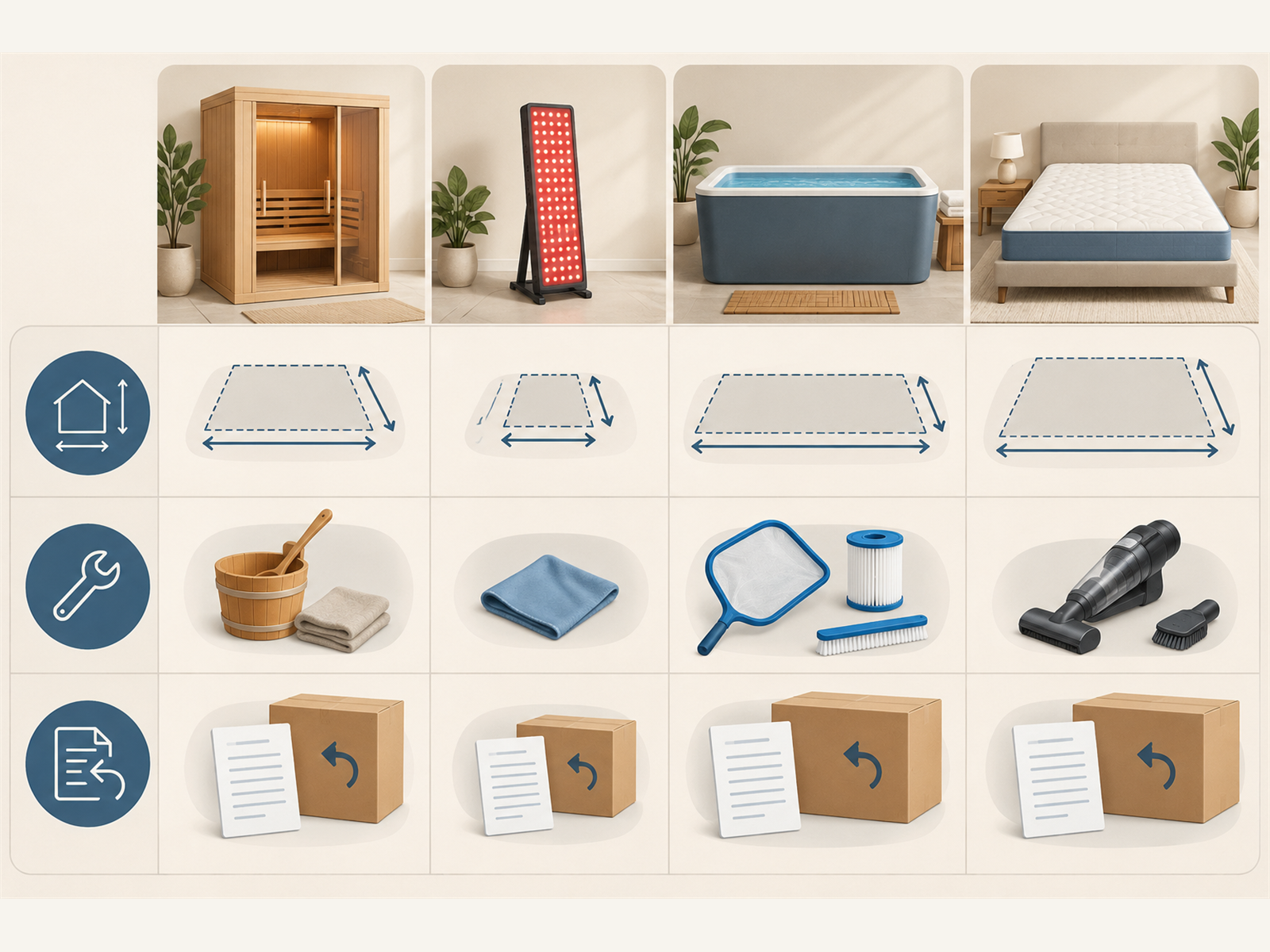
Equipment listings tend to describe the product at rest. Your home has to handle the whole journey: the crate at the curb, the turn through a hallway, the outlet or circuit, the operating space, and the route back out if the unit needs service. Measure the delivery path, not just the finished footprint. Ask whether delivery is curbside or room-of-choice, whether stairs cost extra, and who takes responsibility for transit damage. Keep the exact model’s installation manual beside your measurements.
For a cold plunge, filled weight deserves its own line on the worksheet. The USGS lists water at about 8.33 pounds per US gallon. A 100-gallon fill is therefore about 833 pounds of water before the tub, chiller, occupant, or any other load. That arithmetic does not tell you whether a particular deck or floor is safe; it tells you when to stop guessing and get a qualified assessment.
A $3,800 listing can become a $5,100 project
Here is an illustrative calculation, not a market quote: a $3,800 sauna, $400 freight charge, $750 in electrical work, and $150 in required accessories totals $5,100 before ongoing use or maintenance. The number to compare with another model is $5,100, not the headline $3,800. Replace every example figure with a current written quote for your location and exact configuration.
Then add the costs that recur. A plunge may need filters, approved water-care supplies, replacement components, and a plan for drainage. A sauna may need surface care, heater or controller service, and energy. A red light setup may need a stand or mounting hardware that is not included in the device price. A mattress may come with a trial whose pickup or processing terms matter more than the discount banner. The cheaper sticker price can lose once ownership is included.
For an electricity estimate, multiply the device’s stated kilowatts by hours of operation, then by your utility rate per kilowatt-hour. That produces a planning estimate, not a measured bill: heaters and compressors cycle, and actual use varies. Ask the seller for model-specific consumption information when operating cost could change the decision.
Send one email before checkout
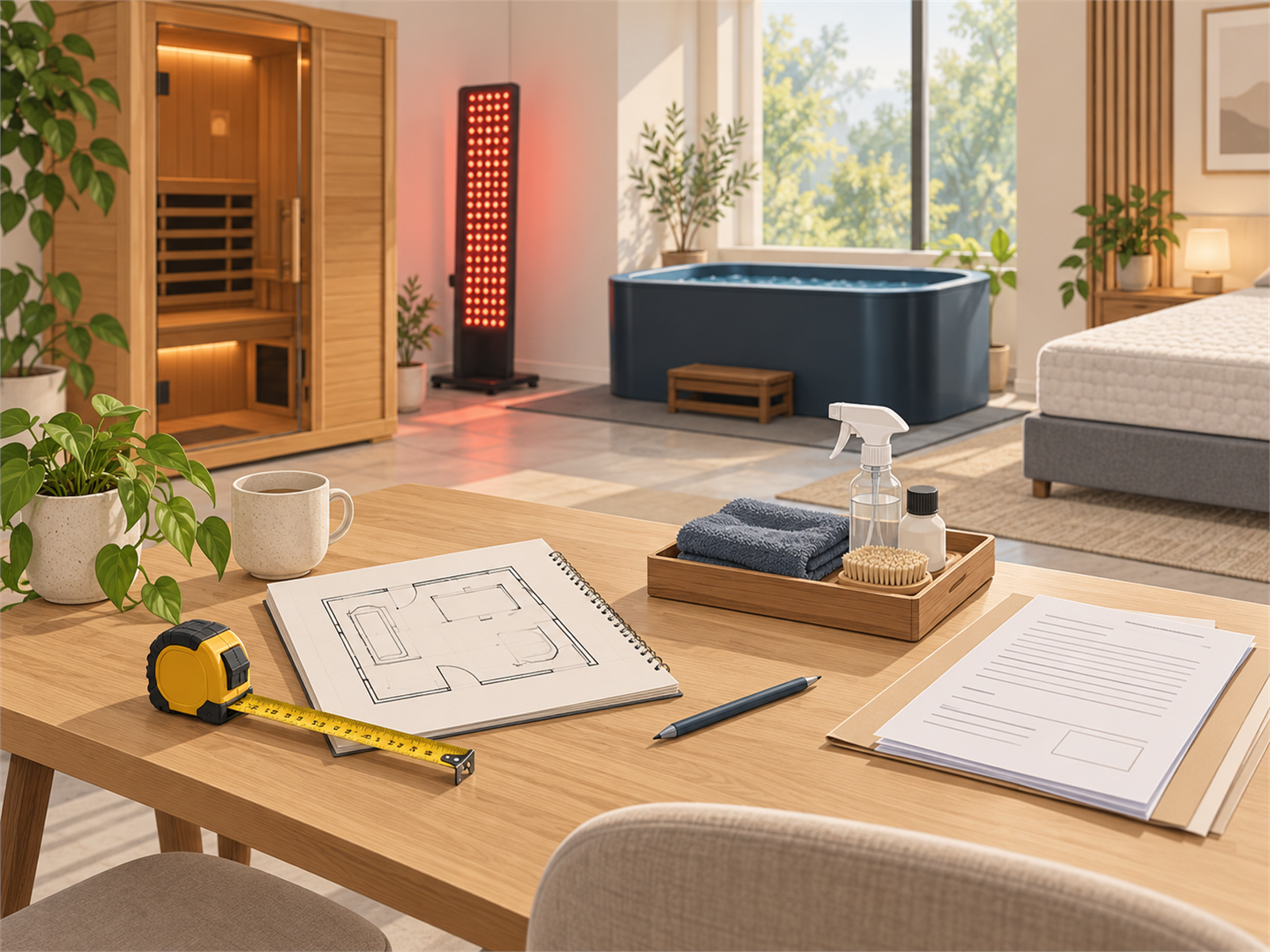
Copy these questions into one message to the seller. A clear written answer is more useful than a friendly phone reassurance because you can compare it with the delivered unit and the policy in force when you paid.
- What is the exact model and configuration, and can you send the current manual and full warranty?
- What is my complete delivered price, including freight, stairs, setup, required accessories, taxes, and any installer work you require?
- What space, electrical, ventilation, drainage, water-care, and service-clearance requirements apply to this exact model?
- If I open, assemble, fill, or try the product, can I still return it? Who pays disassembly, pickup, insured freight, and restocking?
- Which parts and labor are covered, for how long, and who pays travel or shipping if a heavy component fails?
- What evidence supports the specific health or performance claims on this listing, for this model and intended use?
The FTC advises buyers to read the written warranty before purchase. Save the product page, manual, quote, warranty, and return policy with the date. If the seller cannot answer a material question, that unanswered line belongs on the comparison sheet.
Run the 30-day reversal test
Imagine that the product works, but you discover it does not fit your life. The sauna is assembled. The cold plunge is filled. The panel’s box is gone. What would it cost to reverse the purchase, and who would do the work? This is where a generous-looking return window can turn into a freight bill or a nonreturnable exception. Read the exact policy for used and installed equipment before you pay.
Also ask whether the habit itself is realistic. A product you can safely use and maintain every week may earn its place; one that requires an elaborate setup every session may not. There is no virtue in buying the most intense, largest, or most expensive version. The useful choice is the one that fits the goal, the room, the budget, and the routine.
What this guide can and cannot tell you
PHH has not tested or ranked the specific models linked from this hub. We are comparing decision factors and pointing you to category guides, manufacturer manuals, written terms, and independent public sources. Health claims need evidence relevant to the exact outcome and product; the FTC’s health-products guidance explains that standard. The FDA cautions that device registration is not approval, clearance, or authorization.
Heat and cold introduce individual health risks. The American Heart Association discusses cold-water risks, including for people with cardiac histories. Read the exact safety instructions and involve a qualified clinician for personal medical decisions. For installation and load questions, use a qualified local professional.
The PHH standard: a guide should leave you with a question you did not know to ask, a calculation you can repeat, and a clearer reason to buy, wait, or walk away.
FREE PHH PRINTABLE
Get the Smart Home Wellness Buying Guide
Compare red light devices, saunas, and cold plunges with a 12-page buying guide and printable comparison sheet. It covers room fit, total equipment cost, safer questions, upkeep, warranty language, and returns. It is educational and does not replace medical or installation advice.
By signing up, you request the free buying guide and PHH welcome emails. Confirm your email to receive the download link. Unsubscribe at any time. Already subscribed? Open the download page.